First Time Drink Driving Charge in Victoria – What You Need to Know
 May 08, 2026
 Amalia Vicze
If you’ve been caught drink driving in Victoria for the first time, you’re probably feeling rattled.
Most people in this position are thinking the same things:
“Am I going to court?”
“Do I lose my licence straight away?”
“Will this ruin my job or future?”
That reaction is normal.
A first time drink driving charge in Victoria is serious. But it is also very common, and there is a clear, predictable way these cases usually play out. Magistrates see first-time offenders every single day.
This page explains what normally happens, in plain English, so you know where you stand and what to do next.
If you want early advice from lawyers who deal with these cases every week, you can start here:
Or contact us directly: Contact Us
What Is Considered a First Offence Drink Drive in Victoria?
You are treated as a first offence drink driver if you have no prior drink or drug driving findings of guilt related to drink driving.
That includes:
- No previous drink driving convictions
- No drug driving convictions
- No prior refusal offences
It does not matter if:
- You were breath tested before and passed
- You were warned years ago
- You were pulled over but not charged
If this is the first time you are formally charged or issued an infringement for drink driving, you are a first offender.
One important point: people often use “DUI” to mean any drink driving. In Victoria, DUI is a specific charge. It means police say you were so affected by alcohol or drugs that you could not properly control the vehicle. That is more serious than simply being over the limit.
Check the wording on your charge sheet. The exact charge matters.
Will I Lose My Licence for a First Drink Driving Charge?
In most cases, yes.
If you are found guilty, the court MUST cancel your licence and disqualify you from driving for a set period. This applies even if:
- The court does not record a conviction
- You need your licence for work
- This is your first ever offence
Victoria does not have work licences or hardship permits for drink driving.
This surprises many first-time offenders. Years ago, some low-range cases did not result in licence loss. That is no longer the law.
Police can also suspend your licence with a section 85 notice before court in some situations, such as:
- Higher BAC readings
- Learner or P-plate drivers
- Some other risk factors
If police have already suspended you, you must not drive unless that suspension is lifted.
Court Process for First-Time Drink Driving Offenders
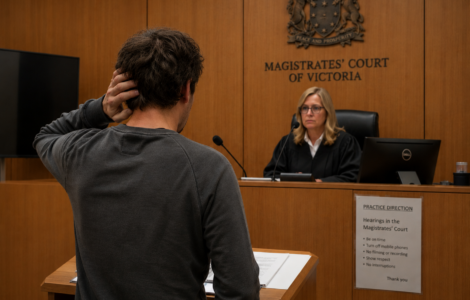
Most first time drink driving charges are dealt with in the Magistrates’ Court.
The first court date is usually short. It is often called a “mention”.
On that date, you will usually:
- Enter a plea of guilty or not guilty, or
- Ask for an adjournment to get legal advice
If you plead guilty, the court will often sentence you on the same day.
If you plead not guilty, the matter is sent on the contest stream.
If you have never been to court before, this guide explains the process step by step in plain terms:
Penalties You Could Face (Fines, Interlock, Licence Suspension)
The penalties depend mainly on two things:
- Your BAC reading
- The type of charge
For a first offence, penalties usually include some combination of:
- A fine
- Licence cancellation and disqualification
- An alcohol interlock condition
- A Behaviour Change Program
Higher readings mean higher penalties.
Low-range first offences usually result in:
- Licence loss
- A fine
- An interlock when you get your licence back
Mid-range and high-range offences increase those penalties quickly.
Even first-time offenders must usually install an alcohol interlock before they can drive again. That means blowing into a device to start the car, paying monthly fees, and complying with strict rules.
What Makes a First Offence More Serious?
Not all first offences are treated the same.
Things that make a first offence more serious include:
- A high BAC reading
- A DUI charge rather than just over the limit
- Refusing a breath or blood test
- A crash or near-miss
- Dangerous driving
- Having passengers at risk
These factors can lead to:
- Longer licence loss
- Higher fines
- Stricter interlock conditions
- A higher chance a conviction is recorded
Driving while suspended or disqualified is a separate and serious offence. If that applies to you, get advice immediately:
Do You Need a Lawyer for a First Offence?
Some people handle a first offence on their own. Others get advice.
A lawyer cannot:
- Stop mandatory licence cancellation
- Promise no conviction
- Magically make the charge disappear
A good traffic lawyer can:
- Explain exactly what outcome is likely in your case
- Check whether the charge and procedure are correct
- Advise whether court or an infringement is the better path
- Help prepare a proper plea
- Reduce the risk of extra penalties beyond the minimum
- Make sure you don’t make mistakes that make things worse
Early advice often means less stress and fewer surprises.
If you want help from lawyers who regularly represent first-time drink driving offenders, start here:
Examples of Real First-Time Drink Drive Outcomes in Court
Most first-time offenders with low to moderate readings see outcomes like:
- A fine
- Licence cancellation for the minimum period
- An interlock requirement
- No jail
Some are able to avoid a recorded conviction if:
- The reading is low
- There is no crash
- Their prior history is clean
- They show insight and remorse
Others receive a conviction, especially where the BAC is higher or the circumstances are more serious.
For a real-world example of how a first offence is handled in court, see: Case Studies
Final word.
What matters now is how you respond.
Getting clear information early helps you stay calm, make better decisions, and limit the damage.
A first offence doesn’t have to ruin your life — but how you respond now matters. Talk to a drink driving lawyer before court.
Other Blogs

-
 Repeat Drink Driving Offence – Is There Any Hope in Court?
If you’ve been caught drink driving again, it can feel like the ground has dropped out from under you. Most people at this point aren’t asking about fines. They’re thinking: “It’s over.”“They won’t go easy on me this time.”“I’m going to jail.” That sense of hopelessness is common. And it’s understandable. But here’s the truth, based […]
 August 10, 2026Read more
-
Should I Represent Myself in Court?
At the outset, the reader may find it ironic to find this article published on a Law Firms website that charges for professional services. However, what follows is, so to speak, the truth, the whole truth and nothing but the truth when it comes to the decision to represent yourself in court. It doesn’t matter […]
Michael Sunderland
May 11, 2026Read more -
How to Get Your Licence Back After Being Caught and Disqualified in Victoria
You cannot just start driving when your disqualification period ends. Once a court cancels your licence, it is completely void. You must officially apply to VicRoads to get a new licence. Depending on your offence, you might also have to go back to the Magistrates’ Court first to get a “licence eligibility order”. Over 90% […]
Amalia Vicze
April 15, 2026Read more -
What Happens After a DUI Charge in Victoria – Step-by-Step Timeline
If you’ve just been charged with a DUI or drink driving offence in Victoria, the waiting is often the worst part. Most people leave the police stop or station thinking: “What happens now?”“Have I already lost my licence?”“When do I go to court?”“What am I meant to do before then?” This page walks through what usually happens […]
Amalia Vicze
April 14, 2026Read more -
The Dangers of AI and The Law
Since the introduction of AI Large Language Models (LLMs) in the early 2020s, people have increasingly relied on AI platforms such as ChatGPT and Google Gemini to assist with day-to-day tasks, from drafting emails to summarising complex information. By 2026, it is widely understood that while these tools are powerful, they are not infallible. One […]
Michael Sunderland
April 10, 2026Read more

 August 10, 2026