Should I elect to have my Traffic Infringement Notice heard in Court?
 Oct 28, 2026
 Michael Sunderland
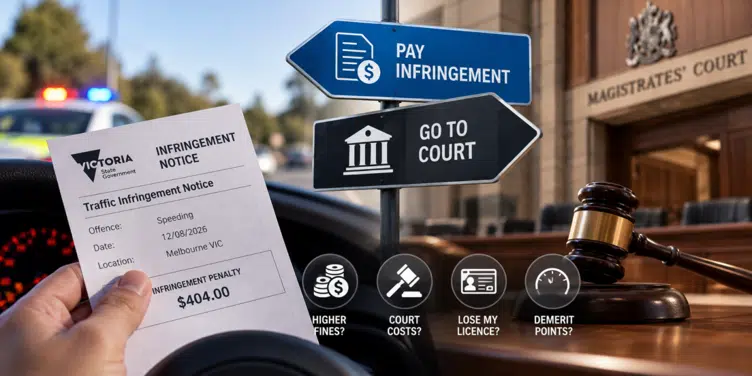
Receiving a Traffic Infringement Notice can be frustrating, particularly where the alleged offence carries a substantial fine, demerit points or the possibility of losing your driver’s licence. In Victoria, motorists generally have the right to elect to have an eligible infringement matter heard and determined by the Magistrates’ Court. However, before making that decision, it is important to understand that taking a matter to Court does not necessarily mean you will receive a more favourable outcome. In some circumstances, the consequences can be significantly more serious than simply accepting the infringement.
The importance of obtaining legal advice before electing to go to Court
Before electing to have a Traffic Infringement Notice heard in Court, it is strongly recommended that you obtain legal advice to understand the potential consequences of that decision. Importantly, once the infringement has been referred to Court and proceedings have commenced, you cannot simply reverse your election and return to paying the original infringement penalty. This means that even if you subsequently reconsider your position, you will still be required to appear before a Magistrate and face the potential consequences of a finding of guilt, including higher fines, prosecution costs, a recorded conviction or mandatory licence disqualification. An experienced traffic lawyer can assess the evidence, identify any available defences and advise whether proceeding to Court is likely to provide a meaningful benefit. What may initially appear to be a straightforward opportunity to challenge a fine can ultimately result in significantly greater financial and legal consequences.
The risks of taking a traffic infringement to Court
One of the most important considerations is that electing to have an infringement heard in Court means the matter will be determined through the judicial process, rather than simply being resolved by payment of the infringement penalty. If you plead guilty or are found guilty, the Magistrate is not necessarily limited to the original infringement amount. Depending on the offence, the Court may impose a higher fine, order you to pay prosecution costs and, in appropriate circumstances, record a conviction.
There is also the practical cost of attending Court. Depending on the circumstances, you may need to take time away from work, engage a solicitor or barrister, and potentially attend multiple hearings if the matter is contested. Even where the Court imposes a reduced fine, the overall financial cost of the proceedings may exceed the amount of the original infringement.
Can going to Court save my demerit points?
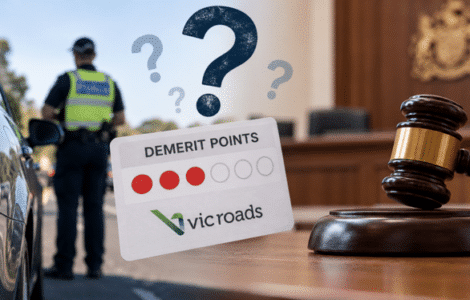
A common misconception among Victorian motorists is that a Magistrate can exercise discretion to remove or reduce demerit points. This is not the case. Demerit points are administered by VicRoads, rather than the Magistrates’ Court. Where a person is found guilty of an offence that attracts demerit points, those points will generally be recorded regardless of whether a conviction is formally recorded.
We have discussed this issue in greater detail in our article, The Demerit Point Misconception: Can Going to Court Save Your Points?
Although the Court cannot directly waive demerit points, a successful defence or negotiations resulting in a different charge may change the consequences. However, simply asking the Magistrate for leniency because you are close to losing your licence will not prevent demerit points from being recorded.
What about mandatory licence loss?
Certain traffic offences in Victoria carry mandatory periods of licence cancellation or disqualification. These commonly arise in matters involving drink driving, excessive speeding and other serious driving offences.
Where legislation prescribes a mandatory minimum period of licence loss, the Magistrate cannot reduce that period below the statutory minimum, regardless of the offender’s personal circumstances. This remains the case even where losing a licence would result in unemployment, financial hardship or significant family difficulties.
Importantly, some offences carry consequences that are more severe when determined by a Court than when dealt with by an infringement notice. In particular, motorists should be aware that electing to contest certain excessive-speed infringements may expose them to a longer period of licence disqualification if found guilty. The applicable legislation, offence and alleged circumstances must therefore be carefully considered before making an election. The operative word in the above paragraph is minimum.
Is it financially worth taking the matter to Court?
The answer depends on the individual circumstances. For a relatively minor infringement involving a modest fine, proceeding to Court solely in the hope of receiving a financial reduction may not be commercially sensible. Once legal fees, time away from work and potential prosecution costs are considered, the expense of challenging the infringement may outweigh any potential saving.
However, the calculation changes considerably where the infringement carries consequences beyond the financial penalty. For someone whose employment depends on holding a driver’s licence, successfully defending an allegation or negotiating an alternative charge may be far more valuable than the infringement amount itself.
The important question is not simply whether the fine can be reduced, but whether there is a legitimate legal or evidentiary basis to challenge the allegation, and whether the potential benefit justifies the associated costs and risks.
When should you consider going to Court?
Electing to have a traffic infringement heard in Court may be appropriate where there is a genuine dispute about the alleged offending, insufficient evidence to establish the charge, a potential legal defence, or an opportunity to negotiate a more appropriate charge with the prosecution.
However, where the allegation is not disputed and the sole objective is to avoid demerit points, mandatory licence loss or payment of a relatively minor fine, Court proceedings may provide little practical benefit and could expose the motorist to additional consequences.
Before you make the election
Every traffic matter is different, and the consequences of electing to proceed to Court should be understood before that decision is made. What initially appears to be a straightforward infringement can involve complex legislative provisions, mandatory penalties and financial risks that are not immediately apparent from the infringement notice itself.
At William Archer Defence Lawyers, we regularly assist clients with traffic infringements, licence-related offences and contested traffic proceedings throughout Victoria. Obtaining legal advice before electing to have your infringement heard in Court can help you make an informed decision about whether challenging the allegation is worthwhile.
Other Blogs

-
 The Demerit Point Misconception: Can Going to Court Save Your Points?
One of the most common misconceptions among Victorian motorists is that electing to have a traffic infringement heard in court may allow them to avoid demerit points. Many drivers believe that a Magistrate has the discretion to impose a fine without recording demerit points, particularly where the offence is minor or the driver has an […]
Michael M Sunderland  October 28, 2026Read more

-
Repeat Drink Driving Offence – Is There Any Hope in Court?
If you’ve been caught drink driving again, it can feel like the ground has dropped out from under you. Most people at this point aren’t asking about fines. They’re thinking: “It’s over.”“They won’t go easy on me this time.”“I’m going to jail.” That sense of hopelessness is common. And it’s understandable. But here’s the truth, based […]
August 10, 2026Read more -
Should I Represent Myself in Court?
At the outset, the reader may find it ironic to find this article published on a Law Firms website that charges for professional services. However, what follows is, so to speak, the truth, the whole truth and nothing but the truth when it comes to the decision to represent yourself in court. It doesn’t matter […]
Michael Sunderland
May 11, 2026Read more -
First Time Drink Driving Charge in Victoria – What You Need to Know
If you’ve been caught drink driving in Victoria for the first time, you’re probably feeling rattled. Most people in this position are thinking the same things: “Am I going to court?”“Do I lose my licence straight away?”“Will this ruin my job or future?” That reaction is normal. A first time drink driving charge in Victoria is serious. But it […]
Amalia Vicze
May 8, 2026Read more -
How to Get Your Licence Back After Being Caught and Disqualified in Victoria
You cannot just start driving when your disqualification period ends. Once a court cancels your licence, it is completely void. You must officially apply to VicRoads to get a new licence. Depending on your offence, you might also have to go back to the Magistrates’ Court first to get a “licence eligibility order”. Over 90% […]
Amalia Vicze
April 15, 2026Read more
 October 28, 2026