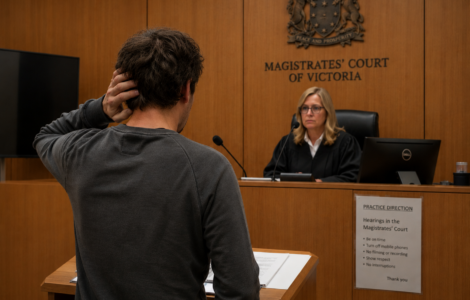
Understanding Mention Hearings for Traffic and Criminal Cases in Victoria
 Feb 20, 2026
 Amalia Vicze & Michael Sunderland

If you have a mention hearing coming up, chances are you feel unsettled.
For most people, this is their first real contact with the court system.
They have a date, a time, and a courtroom, but no clear idea what is about to happen.
People often imagine the worst.
They think they will be questioned.
They think a decision will be forced on them.
They think one wrong sentence could ruin everything.
That is not how a mention hearing usually works.
A mention hearing is the starting point.
It is about organising the case, not punishing you.
Understanding this stage properly takes a lot of pressure off.
This page explains mention hearings in Victoria in plain English, with enough detail to actually calm your nerves.
What Is a Mention Hearing in the Magistrates’ Court?
A mention hearing is the first court date for most traffic and criminal cases.
It is not a trial.
It is not where witnesses give evidence.
It is not where guilt is decided.
The court uses a mention hearing to work out where the case is heading.
The magistrate wants to know:
- what the charge is
- whether you understand it
- whether you are ready to plead
- what needs to happen next
Think of it as a checkpoint.
The court is asking, “Is this case ready to finish, or does it need more time?”
Most mention hearings are short.
Some last only a few minutes.
When Will Your Case Be Listed for Mention?
Your case is usually listed for mention shortly after you are charged or summonsed.
This applies to:
- traffic offences
- minor criminal charges
- matters that started as fines but were taken to court
The paperwork you received will tell you:
- the date
- the time
- the courtroom
If you were given a charge sheet or summons, the first date is almost always a mention.
If you elected to take a fine to court, the first listing is also usually a mention.
This is the court’s way of getting everyone into the system before anything else happens.
Can You Plead Guilty at Mention?
Yes, you can.
Many people plead guilty at the mention hearing.
This often happens when:
- the facts are not really in dispute
- the evidence is clear
- the focus is on reducing the penalty
If you plead guilty at mention and the case is ready, the magistrate may sentence you on the same day.
If it is not ready, the case may be adjourned so:
- reports can be prepared
- paperwork can be gathered
- submissions can be organised
Pleading guilty at mention is common in traffic cases.
It does not mean you are rushing.
It means you have decided not to contest the charge.
What If You Need an Adjournment?
Needing an adjournment is very common.
People ask for adjournments for many reasons, including:
- they have not received the police brief
- they need time to get legal advice or pay their lawyer
- they need time to organise documents
- they need time to think
At a mention, magistrates expect adjournment requests.
This is normal.
You are not expected to have everything sorted on day one.
The court usually grants reasonable adjournments, especially early in the case.
The key is being honest and clear about why you need time.
What Information Should You Bring to Mention?
Even though a mention is not a trial, preparation still matters.
You should bring:
- all court paperwork
- charge sheets or summons
- any fines or notices
- any letters you have received
If you are planning to plead guilty, it can help to bring:
- proof of employment
- character references
- evidence of treatment or courses
You may not use everything at mention, but having it gives you options.
Walking in empty-handed adds stress.
Can the Case Be Finalised at This Stage?
Yes, many cases end at mention.
Traffic cases, in particular, often finish here.
A case can be finalised at mention if:
- you plead guilty
- the facts are agreed
- the court is ready to sentence
Some cases also resolve because:
- charges are withdrawn
- charges are amended
- issues are clarified
For people who are terrified of a long court process, this is often a relief.
However, not all cases can finish at mention.
Finalising a case too early, without understanding the consequences, can cause regret later.
What Happens After Mention if You Plead Not Guilty?
If you plead not guilty at mention, the case does not jump straight to trial.
The court usually sets further steps.
This may include:
- ordering the prosecution to provide evidence
- listing the case for a contest mention
- setting timelines
A contest mention is another management hearing.
It is designed to narrow issues and avoid unnecessary trials.
Many cases that plead not guilty at mention still resolve before a hearing.
Pleading not guilty at mention keeps your options open.
It does not lock you into a full contest.
Do You Need a Lawyer at Mention?
This is one of the most common questions.
The honest answer is: not always, but sometimes it really helps.
You may not need a lawyer at mention if:
- the charge is minor
- you understand the process
- you are confident about what you want to do
You may benefit from a lawyer at mention if:
- your licence is at risk
- the charge is serious
- you are unsure how to plead
- you feel overwhelmed or confused
A lawyer at mention will:
- speak on your behalf
- ask for adjournments properly
- flag issues early
- stop you making rushed decisions
Mention hearings set the tone for the rest of the case.
Mistakes made here can follow you.
Why Mention Hearings Feel Scarier Than They Are
For most people, the fear comes from not knowing the rules.
Court feels formal.
People speak a language you are not used to.
You worry you will say the wrong thing.
In reality, mention hearings are designed to be functional.
Magistrates know most people are nervous.
They are not looking to trap you.
They are trying to move cases along fairly.
The system expects people to need time.
The One Thing That Matters Most at Mention
The most important thing at a mention hearing is not rushing.
Do not plead guilty just to get it over with.
Do not plead not guilty out of fear.
Use the mention to:
- understand the charge
- understand your options
- understand what happens next
Once you know those things, decisions become clearer.
A mention hearing is not the end of the road.
It is the start of the process.
Facing your first court date is stressful.
That is normal.
Understanding what a mention hearing actually is helps restore control.
If you are unsure how to handle your mention hearing, or worried about the impact on your licence or future, getting advice early can make a real difference.
Our lawyers deal with mention hearings every day.
We know how these cases usually play out and where early decisions matter.
If you want help preparing for a mention hearing or having someone speak for you in court, call now for advice and support from day one.
Other Blogs

-
 Repeat Drink Driving Offence – Is There Any Hope in Court?
If you’ve been caught drink driving again, it can feel like the ground has dropped out from under you. Most people at this point aren’t asking about fines. They’re thinking: “It’s over.”“They won’t go easy on me this time.”“I’m going to jail.” That sense of hopelessness is common. And it’s understandable. But here’s the truth, based […]
 August 10, 2026Read more
-
Should I Represent Myself in Court?
At the outset, the reader may find it ironic to find this article published on a Law Firms website that charges for professional services. However, what follows is, so to speak, the truth, the whole truth and nothing but the truth when it comes to the decision to represent yourself in court. It doesn’t matter […]
Michael Sunderland
May 11, 2026Read more -
First Time Drink Driving Charge in Victoria – What You Need to Know
If you’ve been caught drink driving in Victoria for the first time, you’re probably feeling rattled. Most people in this position are thinking the same things: “Am I going to court?”“Do I lose my licence straight away?”“Will this ruin my job or future?” That reaction is normal. A first time drink driving charge in Victoria is serious. But it […]
Amalia Vicze
May 8, 2026Read more -
How to Get Your Licence Back After Being Caught and Disqualified in Victoria
You cannot just start driving when your disqualification period ends. Once a court cancels your licence, it is completely void. You must officially apply to VicRoads to get a new licence. Depending on your offence, you might also have to go back to the Magistrates’ Court first to get a “licence eligibility order”. Over 90% […]
Amalia Vicze
April 15, 2026Read more -
What Happens After a DUI Charge in Victoria – Step-by-Step Timeline
If you’ve just been charged with a DUI or drink driving offence in Victoria, the waiting is often the worst part. Most people leave the police stop or station thinking: “What happens now?”“Have I already lost my licence?”“When do I go to court?”“What am I meant to do before then?” This page walks through what usually happens […]
Amalia Vicze
April 14, 2026Read more

 August 10, 2026