What Happens at a Contest Hearing for Traffic Offences in Victoria
 Mar 13, 2026
 Amalia Vicze & Michael Sunderland

If your traffic case is heading to a contest hearing, this usually feels like a turning point.
Up until now, it may have felt manageable.
A fine.
A charge.
A court date that came and went.
A contest hearing feels different.
This is where police give evidence.
This is where a magistrate decides whether the charge is proven.
This is where people start worrying about jail, losing their licence, or having their record changed forever.
Most people at this stage are asking the same things.
Have I gone too far?
Is this a mistake?
What actually happens on the day?
This page walks through the contest hearing process step by step, in plain English, based on how traffic cases are actually run in Victoria.
No scare tactics.
No theory.
Just the reality of what happens.
When Does a Traffic Case Go to a Contest Hearing?
Most traffic cases never reach a contested hearing.
A case only goes this far when a few things line up.
First, you plead not guilty.
Second, the issues cannot be resolved earlier.
Third, the prosecution decides to keep running the case.
Many people think pleading not guilty automatically locks them into a hearing.
That is not true.
Before a hearing is set, the court gives several chances to resolve the case.
This includes mentions, contest mentions, and discussions between the parties.
A contested hearing is the last step.
It only happens when the court needs to decide the case based on evidence.
Pre-Hearing Requirements: Summary Case Conference and Brief of Evidence
Before a contested hearing can happen, certain things must be done.
One of the most important requirement is the brief of evidence.
The brief is the prosecution’s case.
It includes witness statements, police reports, certificates, and any recordings or photos.
You are entitled to see this material before the hearing.
Once the brief is provided, a summary case conference usually takes place.
This is a structured discussion between your lawyer and the prosecutor about your case.
The purpose is not argument for its own sake.
The purpose is to see whether:
- the charge should continue
- the charge should be changed
- the case can resolve without a hearing
- the issues can be narrowed
Many traffic cases finish here.
Charges are sometimes withdrawn.
People sometimes change their plea once the evidence is clear.
Only cases that still need a decision go on to a contest hearing.
The Role of the Magistrate and Court Procedure
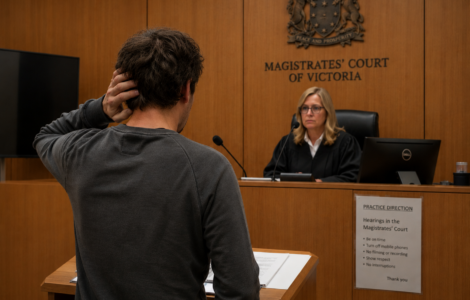
At the contested hearing, one magistrate controls the courtroom.
There is no jury.
There is no performance.
The magistrate’s role is to:
- hear the evidence
- apply the law
- decide whether the charge is proven
The magistrate keeps the process structured and fair.
They decide:
- who speaks
- when questions are asked
- what evidence is allowed
If something is irrelevant or unfair, it is usually stopped quickly.
Traffic contested hearings are formal, but they are not chaotic.
Presenting Evidence and Calling Witnesses
The prosecution presents its case first.
This usually starts with police witnesses.
They give evidence about:
- what they observed
- what actions they took
- what tests were done
- what procedures were followed
Other witnesses may be called if they are relevant.
The prosecution may also rely on:
- body-worn camera footage
- dash camera footage
- photographs
- certificates or reports
After the prosecution finishes, the defence decides whether to call evidence.
You do not have to give evidence.
That choice depends on the case.
Sometimes giving evidence helps.
Sometimes it creates risk.
There is no single right answer.
Cross-Examination and Legal Submissions
Cross-examination is where witnesses are questioned about their evidence.
This is not about arguing or attacking for the sake of it.
It is about:
- testing accuracy
- exposing gaps
- clarifying inconsistencies
Not every witness needs to be cross-examined.
Sometimes the issues are clear without it.
After all evidence is finished, legal submissions are made.
This is where each side explains how the law applies to the evidence.
In traffic cases, submissions are usually focused and practical.
The magistrate may ask questions during this stage.
How the Magistrate Makes a Finding
After hearing everything, the magistrate makes a decision.
They are not guessing.
They are not deciding based on feelings.
They ask:
- has each element of the charge been proven
- is the evidence reliable
- does it meet the required standard
If there is doubt, the charge is dismissed.
If the charge is proven, the finding is guilty.
Sometimes the decision is given straight away.
Sometimes it is given later.
Both are normal.
Sentencing After a Finding of Guilt
If you are found guilty, sentencing usually happens immediately.
This is where the penalty is decided.
The magistrate considers:
- the seriousness of the offence
- your driving history
- whether anyone was hurt
- whether this is a first offence
- whether there are mandatory penalties
Possible outcomes can include:
- a fine
- licence suspension or cancellation
- a community-based order
- in rare cases, jail
What can happen and what usually happens are different.
For most traffic offences, jail is uncommon.
Licence loss is far more common and often the biggest concern.
This is where preparation matters most.
Can You Appeal the Outcome of a Contest Hearing?
In some cases, yes.
If you believe the decision or sentence is wrong, there is a right to appeal.
Appeals are a second contested hearing in the County Court. They take longer and cost more.
They are limited.
They are time-sensitive.
Appealing carries risk and should never be done lightly.
The Reality of Contest Hearings
A contested hearing is serious, but it is not the disaster many people imagine.
Most traffic hearings are controlled, professional, and focused.
Magistrates are not there to punish people for defending themselves.
They are there to decide cases fairly.
The biggest mistakes usually happen before the hearing, not during it.
Rushing decisions.
Misunderstanding the evidence.
Underestimating licence consequences.
Understanding the process does not remove the stress, but it gives you back control.
If you are heading toward a contested hearing, the most important thing is knowing what you are walking into and why.
Going to a contested hearing is not about bravado.
It is about preparation, risk, and informed choice.
If you are facing a contested hearing for a traffic offence and want experienced help preparing your case, speak with a lawyer who deals with these hearings every week and understands how they actually run in Victorian courts.
Contact us for a free consultation and clear advice about your next steps.
Other Blogs

-
 Repeat Drink Driving Offence – Is There Any Hope in Court?
If you’ve been caught drink driving again, it can feel like the ground has dropped out from under you. Most people at this point aren’t asking about fines. They’re thinking: “It’s over.”“They won’t go easy on me this time.”“I’m going to jail.” That sense of hopelessness is common. And it’s understandable. But here’s the truth, based […]
 August 10, 2026Read more
-
Should I Represent Myself in Court?
At the outset, the reader may find it ironic to find this article published on a Law Firms website that charges for professional services. However, what follows is, so to speak, the truth, the whole truth and nothing but the truth when it comes to the decision to represent yourself in court. It doesn’t matter […]
Michael Sunderland
May 11, 2026Read more -
First Time Drink Driving Charge in Victoria – What You Need to Know
If you’ve been caught drink driving in Victoria for the first time, you’re probably feeling rattled. Most people in this position are thinking the same things: “Am I going to court?”“Do I lose my licence straight away?”“Will this ruin my job or future?” That reaction is normal. A first time drink driving charge in Victoria is serious. But it […]
Amalia Vicze
May 8, 2026Read more -
How to Get Your Licence Back After Being Caught and Disqualified in Victoria
You cannot just start driving when your disqualification period ends. Once a court cancels your licence, it is completely void. You must officially apply to VicRoads to get a new licence. Depending on your offence, you might also have to go back to the Magistrates’ Court first to get a “licence eligibility order”. Over 90% […]
Amalia Vicze
April 15, 2026Read more -
What Happens After a DUI Charge in Victoria – Step-by-Step Timeline
If you’ve just been charged with a DUI or drink driving offence in Victoria, the waiting is often the worst part. Most people leave the police stop or station thinking: “What happens now?”“Have I already lost my licence?”“When do I go to court?”“What am I meant to do before then?” This page walks through what usually happens […]
Amalia Vicze
April 14, 2026Read more

 August 10, 2026